Atradius Atrium
Get direct access to your policy information, credit limit application tools and insights.

 Canada
 Australia
 Austria
 Belgium
 Brazil
 Bulgaria
Canada
Bulgaria
Canada
 China
China
 Czech Republic
 Denmark
 Finland
 France
 Germany
 Greece
 Group
Group
 Hong Kong SAR
 Hungary
 India
India
 Ireland
 Italy
Italy
 Japan
Japan
 Lithuania
 Mexico
 Netherlands
 New Zealand
 Norway
 Poland
 Portugal
 Romania
 Singapore
 Slovakia
 Slovenia
 Spain
Spain
 Sweden
 Switzerland
 Turkey
 United Arab Emirates
 United Kingdom
 United States

The closures and obstruction of shipping traffic in the Gulf region and persistently high energy prices are having a major impact on the chemicals industry. Chemicals is among the industries most severely affected by the Gulf conflict, which is impacting access to feedstocks and the price of fuel.
The sector accounts for 25% of global industrial energy usage. And, in addition to being an energy source, oil and gas are a key feedstock for which limited alternatives exist. The Gulf region supplies about half of global ethylene glycol exports and almost 40% of methanol, both essential for plastics and industrial chemicals.
Additionally, because chemicals are an important precursor for a wide range of industrial goods, they're an important transmission channel through which oil and gas prices feed into manufacturing costs, producer prices, and ultimately consumer inflation.
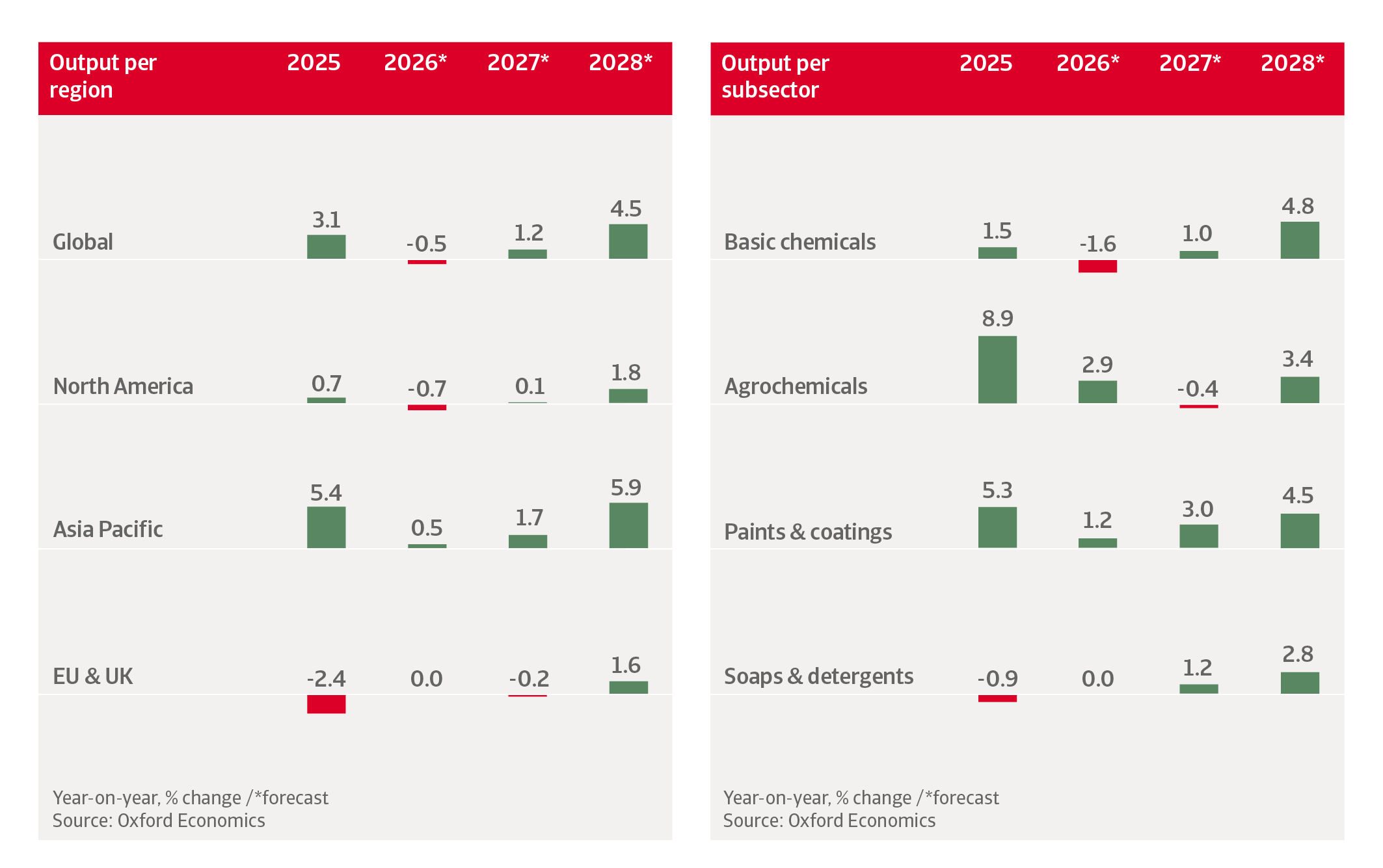
Global chemicals production is forecast to contract by 0.5% in 2026, with an 8.6% decrease in the Middle East. Asia has borne the brunt of the disruption to date, as its economies' deep dependence on Middle Eastern oil and gas has left them especially exposed. Chemicals output in Asia Pacific is expected to slow down from 5.4% in 2025 to 0.5% this year.
Provided that a preliminary US-Iran agreement can be reached in the remainder of 2026 and early 2027, oil and gas supplies should gradually recover and prices decrease. In such a scenario, we expect global chemicals production to rebound by 1.2% in 2027. Among the subsectors, we expect to see basic chemicals output to grow by 1.0%, paints and coatings by 3.0%, and soaps and detergents by 1.2% in 2027.
However, in a downside scenario of sustained disruption in the Strait of Hormuz, accompanied by disruptions of maritime traffic in the Red Sea, energy prices would remain elevated for longer. In such a case, global chemicals production would shrink by 3.2% in 2027, with contractions of 4.9% in Asia Pacific and 1.8% in Europe and the US.
Another issue impacting the global chemicals industry is ongoing trade policy uncertainty. Chemical products, particularly upstream basic chemicals, are highly traded goods. Today, the industry’s deep integration into nearly all areas of industrial production means it is vulnerable to the impact of tariffs and any issues arising out of trade policy decisions. We expect the sector will continue to suffer from the wide array of tariffs the US has announced and implemented. Retaliatory tariffs will additionally weigh on the sector. Major chemical buyer industries are also affected. The automotive sector is a primary target of US tariffs, and the resulting decline in US demand for imported vehicles is rippling through the supply chain, ultimately reducing demand for chemical input.
.2026-10-07-13-07-46.png)
After a 1.2% increase in 2025 we expect US chemicals production to contract slightly by 0.7% in 2026, although the domestic economy is growing by more than 2%. While overall US industrial production performance remains solid, a relatively large share of growth is concentrated in sectors that are not highly chemicals-intensive, such as electronics, electrical equipment, and AI. In 2027 and 2028 we forecast US chemicals output to increase again due to higher demand from chemicals-intensive sectors like automotive and construction. The US administration’s expansionary fiscal policy should lift business investment, boosting demand for manufactured and chemical goods as well as chemicals capital spending.
Energy-wise, US chemicals production is mainly based on natural gas for both fuel and power sources, as well as a feedstock for producing chemicals such as ammonia, methanol, hydrogen, plastics, and petrochemicals. The industry is relatively insulated from the disruptions caused by the conflict in the Middle East due to high domestic shale gas reserves. Investments in US shale gas-related projects over the past decade have been large, resulting in more stable gas prices, a reliable supply chain, and lower cost of producing chemicals such as ethylene. The US is a net energy exporter and not susceptible to the loss of LNG supplies from the Gulf. This has played out well for the industry as domestic gas prices have decreased while global chemical prices have increased, which has boosted profitability for producers. This trend will likely persist as long as disruptions in the Middle East continue. US LNG exports are capacity-constrained, reducing the risk of sharp rises in domestic natural gas prices.
All this is helping US chemicals producers to enjoy an advantage in cost competitiveness over their European and Asian peers. In the long-term US natural resources should help to drive US chemicals growth and attract investment from overseas, cementing the cost advantage.
Domestically produced semiconductors, lithium-ion batteries, solar panels, and other clean technologies are providing demand for chemicals. However, Washington has pulled back USD 3.7 billion in clean energy awards. The US Department of Energy is also restructuring, revising, or eliminating more than USD 83 billion in loans and conditional commitments made under the previous US government, covering clean-energy, manufacturing, and transport projects. This is part of a broader rollback of federal support for renewable energy, emissions reduction, and electric vehicles. The chemicals sector has also been directly affected by cuts to industrial decarbonisation funding.

After strong increases in 2024 and 2025, China’s chemical production growth is expected to slow to 1.6% in 2026. Construction volumes will remain low, reducing demand for chemical goods from a key downstream sector. That said, disruptions to oil and gas shipments through the Strait of Hormuz have not hit China's chemicals producers as hard as those elsewhere in Asia. With coal serving as a viable feedstock for a large share of domestic chemical production and China’s sizeable crude reserves, the sector has a decent cushion against Middle East-driven supply and price shocks.
US tariffs continue to weigh on exports of both chemicals and goods from key buyer industries. That said, Chinese exports remain strong, in particular to Southeast Asia and South Korea. Robust overseas appetite for Chinese products should filter upstream into chemicals demand. In international comparisons Chinese chemicals production remains competitively priced, and the sector is a strategic priority for the Chinese authorities. We expect chemicals output to grow by 1.5% next year, followed by a 7% surge in 2028.
China has a significant overcapacity issue, impacting margins for many Chinese chemicals producers, mainly in the ethylene, polypropylene, ammonia, and methanol segments. The National Development and Reform Commission is pressing to shut down ageing, inefficient plants in an effort to bring supply back into balance. The shift to a consumer-led economy and a rising middle class will benefit sectors like soaps and detergents and speciality chemicals.

Indian chemicals output growth is expected to slow down to 2.0% in 2026 as the Gulf conflict has increased costs, disrupted supply chains, and squeezed margins for Indian chemical producers. However, the strong domestic market and supportive industrial policies are sustaining sector performance. Growth is expected to accelerate again next year, by more than 4%. An expanding economy, increasing population, and government policies supporting foreign direct investment will spur growth over the coming decade.
.2026-10-07-09-00-37.png)
We expect Japan’s chemicals output to contract by 5.9% in 2026, with the production of basic chemicals experiencing the biggest hit. This decrease is mainly due to the closure of the Strait of Hormuz, as producers in Japan rely heavily on oil from the Middle East (around 95% of its oil supplies coming from the region). However, Japan is increasing imports of naphtha and crude oil from sources outside the Middle East, such as the US and Algeria in a bid to reduce exposure to the Gulf conflict. We expect chemicals output to rebound in 2027 and 2028.
In the long run, growing Chinese oversupply is a key challenge for the sector and is forcing Japanese producers to rationalise production. We expect that Japanese chemicals producers will increasingly shift away from low-value added chemicals towards less energy-intensive, high-quality, premium-priced chemicals. More specialised products for automotive, electronics, and life sciences should provide higher margins.

Currently the regional chemicals sector is severely impacted by the Gulf conflict, with chemicals production growth forecast to slow down to 0.1% in 2026. Because producers are heavily reliant on naphtha and LNG deliveries from the Middle East, the closure of the Strait of Hormuz has led to higher prices for oil, naphtha and petrochemical feedstocks, delivery delays, and even supply chain disruptions. Among the areas most affected are integrated refining–petrochemical hubs dependent on multiple hydrocarbon-based feedstocks. Delivery delays have already led to force majeure declarations at several refineries in Singapore, Indonesia, and Thailand. Downstream sectors such as plastics have been under pressure due to higher raw material costs.
Chemicals producers across Southeast Asia are expected to face reduced profitability and sustained margin pressure through 2026
Thailand and Singapore are the most vulnerable due to their high dependence on imports and large standalone cracking capacity. Chemicals production in Thailand is expected to slow down to 0.2% in 2026 and even to contract by 8.9% in Singapore. Indonesia and Vietnam face a similar feedstock exposure but benefit from relatively stronger domestic demand growth. Malaysia is comparatively more resilient due to gas-linked capacity, although downstream derivatives remain exposed to higher input costs. Overall, chemicals producers across Southeast Asia are expected to face reduced profitability and sustained margin pressure through 2026. Businesses are only able to pass on the higher feedstock costs to customers to a limited extent, as demand from downstream industries is relatively weak and competition from China is fierce.
Despite the current issues the regional chemicals sector is still relatively resilient, and non-payments have generally remained stable. Provided that a preliminary US-Iran agreement is reached in the remainder of 2026 and early 2027 and oil and gas supply through the Strait of Hormuz gradually recovers, we expect chemicals production in Southeast Asia to rebound by 5% in 2027. Southeast Asia accounts for about 5% of global chemicals production, and this share is expected to increase in the coming years due to rising demand from the region’s growing economies.

We expect chemicals production in the EU and UK to level off in 2026 and 2027 after a 2.4% contraction in 2025. The industry is heavily affected by the sharp rise in oil and gas prices due to the Gulf conflict, which makes feedstocks and energy used to create chemicals more expensive. That said, European chemicals producers are partly benefitting from competitive advantages compared to East Asia (mainly Japan, South Korea, and Taiwan). Producers there are facing even higher input prices and even production disruptions, as they are heavily dependent on oil and gas feedstock deliveries from the Gulf. A rush to stockpile materials in the earlier phases of the Gulf conflict has also sustained demand for European chemicals, although this is a temporary phenomenon.
For the European chemicals industry, cost relief is not on the horizon, keeping producers' margins under strain
In the course of 2027 European chemicals production should benefit from higher demand from downstream sectors like construction and a modest rebound in regional industrial production. However, this does not translate into a short- and mid-term relief for the sector, as major competitive disadvantages remain, particularly relative to China and the US. Structurally elevated gas prices, worsened by a current record low gas in storage, mean that cost relief is not on the horizon, keeping producers' margins under strain. US Henry Hub gas prices are lower than European ones, benefitting US competitors. At the same time global oversupply, mainly from China, is pushing prices downward, putting low-margin suppliers from Europe under pressure. All this at a time when European chemical businesses face growing pressure to invest in automation, transformation, and digitalisation.
In order to cut costs and to improve operational efficiency, several facilities have been closed over the past two years in the EU and the UK. We expect an orderly but significant consolidation process in the coming years, as the European cost base remains structurally too high and China continues to build capacity. SMEs without energy hedging and without the investment power for decarbonisation are particularly at risk, while large, efficient players focusing on speciality chemicals enjoy a competitive advantage.

Chemicals production in Germany is forecast to increase by just 1.1% this year after a 3.4% contraction in 2025. The sector is currently facing a combination of high energy prices, modest domestic and European demand, US tariffs, and increasing global competition, in particular from China. High costs, regulatory requirements, and global trade shifts are increasingly influencing investment decisions.
The sector is also facing some logistical challenges. Due to a draught this summer water levels on the Rhine have fallen, meaning that boats cannot carry the same amount of cargo as usual. This is affecting inbound feedstock and products leaving chemical facilities, with some declaring force majeure.
Credit risk has increased for basic chemicals SMEs without pricing power, as well as for smaller businesses without energy hedging and lack of funding for investment in decarbonisation. Also vulnerable are companies with high dependency on gas and suppliers affected by tariffs. Access to finance has become more challenging for a number of chemical companies, particularly SMEs and businesses facing elevated energy costs. Declining order intake is also making it more difficult to finance necessary innovations from internal sources.
That said, performance of speciality chemicals remains more robust, a segment in which German producers have high expertise. Additionally, demand is rising for chemicals in sustainability-focused sectors, including electric vehicles, as well as life sciences.
Download the full report in the related documents section below.
To explore how to strengthen your own credit risk strategy, get in touch with us and see how we can help you stay ahead.

