Atradius Atrium
Accédez directement aux informations sur votre police, aux outils de demande de limite de crédit et aux informations.

 Canada
 Allemagne
 Australie
 Autriche
 Belgique
 Brazil
 Bulgarie
Canada
Bulgarie
Canada
 Chine
Chine
 Danemark
 Émirats arabes unis
 États-Unis
 Finlande
 France
 Grèce
Grèce
 Groupe
 Hong Kong
 Hongrie
 Inde
Inde
 Irlande
 Italie
 Japon
Japon
 Lituanie
 Mexique
 Norvège
 Nouvelle-Zélande
 Pays-Bas
 Pologne
 Portugal
 République tchèque
 Roumanie
 Royaume-Uni
 Singapour
 Slovaquie
 Slovénie
 Spain
Spain
 Suède
Suède
 Suisse
 Turquie

We expect electronics/ICT production to grow by 10.3% in 2026 and by 6.5% in 2027 after a 10.2% in 2025.
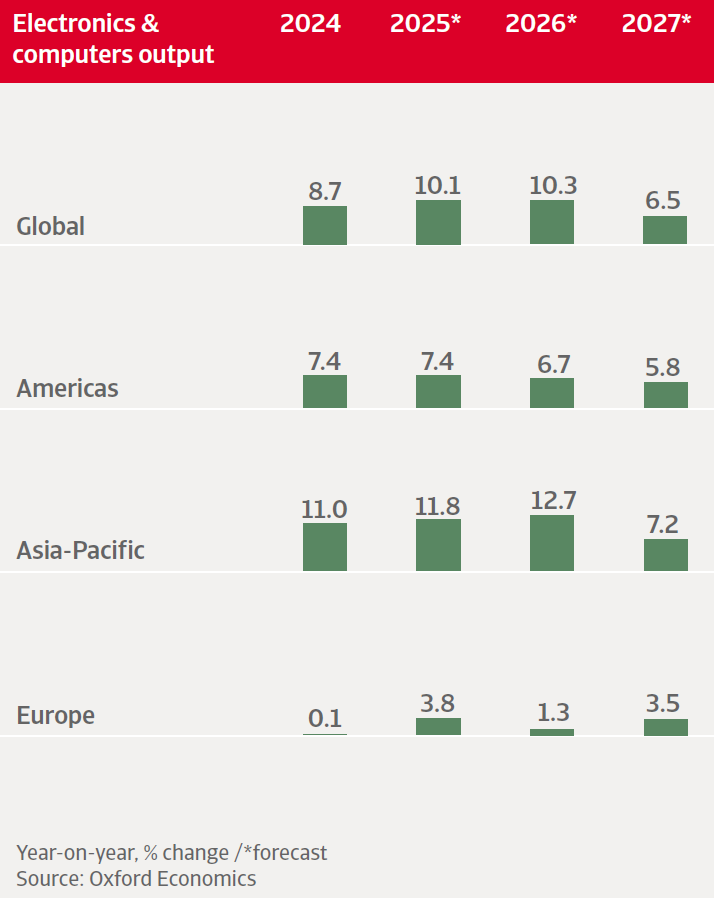
Worldwide semiconductor sales are expected to grow by 18.8% this year, following 22.8% in 2025, led by cutting-edge logic and memory chips for AI data centres. Strength in tech investment is particularly apparent in the US, but the positive spillover ripples through to East Asia.
As chipmakers shift production capacity towards cutting-edge chips for AI use with higher margins, global production capacity for traditional memory chips is dwindling. The shortage and associated price increases are harmful for purchasers of traditional memory chips such as producers of smartphones, PCs, consumer electronics, electrical machinery, and automobile manufacturers.
“Chipmakers’ shift to high margin AI chips is shrinking traditional memory chip supply, driving shortages and price hikes across buyer sectors like PC and consumer electronics producers.”
Producers in those sectors could still acquire memory chips if they pay high prices, but they have to compete with large tech firms investing into AI, who are often better financially resourced. Therefore, they will either have to pass on higher costs for memory chips to consumers, leading to lower demand, or absorb the higher input costs into their margins. Most likely is a combination of these two.
There is the potential downside risk that a sharp decline in confidence in the future benefits of AI could trigger an abrupt end to the current investment boom, resulting in a pronounced AI bubble burst. In such a scenario, US tech stocks would fall by around 25%, and US and Asian high-tech businesses and economies would see a sharp hit.
Comprehensive tariffs on electronics under US Section 232 with no exemptions remain a downside risk. This could be a speedbump for Asian electronics exports to the US.
We expect US electronics/ICT production to grow by 7.4% in 2026, followed by a 6.2% increase in 2027. Electronic components and boards, which include semiconductors, will continue to drive headline growth due to strong AI demand and the US administration’s push to onshore production of strategically important components.
Additionally, cloud computing and storage, automated data processing, and cybersecurity solutions, such as colocation services, are increasingly becoming priorities for businesses.
Output in the electronic components and boards segment is forecast to grow by 12.3% in 2026 after a 14.7% increase in 2025. Nvidia’s Blackwell –the firm’s most advanced chips designed for next-gen AI – started domestic production in TSMC’s Arizona plant in October 2025. US chip production capacity will likely continue to ramp up over the coming years due to high investment by major producers. TSMC’s total investment in the US is set to total USD 165 billion, while both Samsung Electronics and SK Hynix are also investing heavily in the US.
Although there is the downside risk of an AI overhype – the latest signal being the increasing use of debt-financing – high tech firms’ balance sheets are generally healthy, with limited systemic risks.
Production in the computer and office equipment segment increased 13.6% in 2025. This was due to a replacement cycle, where people and businesses that invested in equipment during the pandemic are now looking to upgrade and replace their tech. Growth will slow down in 2026, but remain solid at 4.9%.
US production of telecommunications equipment has grown strongly in recent years due to upgrades to broadband infrastructure and to 5G mobile systems. After a 16.1% surge in 2024, output growth cooled down somewhat to 5.5% in 2025, and in 2026 we expect a 5.7% increase.
Apart from the semiconductor segment, a revitalisation of US electronics manufacturing would only be possible either through reskilling and training of the domestic workforce (a highly costly and lengthy endeavour) or through the use of low-cost labour from overseas.
We expect Chinese electronics and computer production to increase by 17.7% in 2026 after a 12.0% surge in 2025. Production of electronics and boards (including semiconductors) is forecast to grow by 28% this year.
After the US recently loosened its chip export control, China launched a probe into US company Nvidia on the grounds of security risks. This leaves local firms to take up market share, boosting domestic production.
The high-tech sector is a key area of the government’s targeted industrial strategy, with subsidies of about USD 150 billion spent over the past ten years. Beijing has long emphasised the importance of self-sufficiency in chip production, encouraging more domestic investment in technology (AI, data centres, big data, etc.). Those efforts have accelerated since October 2022, when the US introduced sanctions on high-tech exports to China.
China is broadening its supply chain reach, not only in chip fabrication, but also in machinery, materials, and design. Despite a technological backlog in advanced chip production, it seems that China is nevertheless moving up the chipmaking value chain.
However, while China's progress is notable, significant challenges remain. The country continues to face technological gaps and a reliance on foreign equipment, particularly in the production of high-end chips. These obstacles may slow the pace of advancement. Achieving full self-sufficiency in advanced semiconductor manufacturing will remain a complex process that could take considerable time.
Japan has made a structural shift away from producing lower-value items such as consumer electronics and is investing to expand its chip production capacity. Japanese electronic components and boards output is forecast to grow by 4.6% in 2026, as components such as capacitors and resistors benefit from ongoing AI-related demand.
The government has allocated sizeable funding towards Rapidus to produce chips by a local company. However, Rapidus is struggling to attract private investors, and still well behind leading firms such as TSMC in producing high-end chips. The company could secure clients as part of its supply-chain diversification strategy but is unlikely to emerge as a major challenger to its leading global competitors.
South Korea specialises in memory chips, meaning it benefits from the demand for high-end chips from AI-related data centres. Two of the largest global memory chipmakers, SK Hynix and Samsung Electronics, are well-placed to benefit from the ongoing AI demand.
Electronic components and boards output is forecast to grow by 7.6% in 2026 after a 12.6% increase in 2025. Demand for high bandwidth memory chips remains strong, and the production capacity for 2026 has reportedly already been booked.
While some production will move to the US in order to avoid tariffs, continued investment locally will ensure South Korea will remain a key global player. The government’s commitment to keeping the country a major player in the advanced semiconductor field (e.g. by supporting programmes to train chip design specialists) will reinforce existing technological strength.
After a whopping 27.7% output increase, growth in the Taiwanese electronics/ICT sector is likely to remain at a double-digit rate this year. Demand for cutting-edge AI chips continues to underpin extremely strong production growth, and export orders remain strong.
Taiwan-based TSMC, the world’s biggest contract chip manufacturer, has a near-monopoly on high-end chips. Faced with the tariff threat by the US, the firm decided to heavily invest in the US and to build several more fabs there. However, most high-end chips production will likely remain in Taiwan.
Southeast Asian countries continue to strengthen their role in the global electronics/ICT supply chains and capture a larger share of global production. Chinese exporters are incentivised to either re-route trade or move production to third countries due to US tariffs, while the threat of another escalation of the trade dispute still looms.
As China moves up the value chain, ASEAN countries—with their lower labour costs—are attracting more electronics/ICT. Even without the driving force of tariff arbitrage, China would face growing competitiveness from Southeast Asia as domestic cost pressures increase.
“As China climbs the value chain and faces rising costs, Southeast Asia is gaining a larger share of global electronics manufacturing.”
Indonesia’s ICT sector is seeing strong growth in electronics assembly, telecom equipment upgrades for 5G, and digital infrastructure. Rising demand for cloud services and consumer electronics adds momentum, while component production is gradually expanding. Supported by foreign investment and ASEAN spillover, the sector is projected to grow at a 5–6% CAGR through 2028, reinforcing Indonesia’s role as a competitive hub in global ICT supply chains.
We expect Malaysia’s electronics production to grow by 5.4% in 2026. The country´s importance in chip production has increased over the past couple of years. Government initiatives such as the National Semiconductor Strategy and its existing strength in the back-end process of chip production place Malaysia´s electronics industry in a good position to grow further in the coming years. Since chip production is one of the key sticking points in US-China trade relations, Malaysia stands to benefit from potential migration of production out of China.
Vietnam is also well-positioned to capture demand for diversification away from China. The country is interlinked to the Chinese supply chain, with spillover benefits likely accruing from China’s export-driven manufacturing push. Electronics/ICT production growth is set to accelerate to 10.4% in 2026 after an 8.4% increase in 2025.
Electronics assembly and component manufacturing scaled up rapidly over the past 15 years. The country is climbing up the value chain into semiconductors and printed circuit board production. Vietnam is major producer of consumer electronics with the sector having grown more than tenfold since 2010. Vietnam is the largest exporter of electronic products to the US within the ASEAN, worth USD 59 billion in 2024.
Compared to growth rates in Asia Pacific and the US, the European electronics/ICT sector continues to underperform. After a 0.8% contraction in 2024 and a 2.6% rebound in 2025, we expect production of electronics and computers in the EU and the UK to grow by just 1.5% in 2026.
The region is not specialised in the production of the high-end chips used for AI, nor is there a strong AI investment boom going on so far. The stagnation among core economies will have implications for sectoral output. That said, in 2026 electronics production will grow faster than the average manufacturing sector in the region.
Demand will be supported by growing digitalisation, the Internet of Things, and robotics. Over the long-term, higher military spending in the region should add to sector growth. This is particularly the case for Germany, where a change in fiscal rules is providing the room to expand spending.
With a 3.9% increase, electronic components and boards will be the fastest growing electronics/ICT subsector in 2026, contributing the most to headline growth. The region’s semiconductor production is tilted towards power chips with industrial use, which leave it exposed to a weak regional industrial outlook.
The weak investment outlook in the EU and the UK continues to weigh on capital-reliant precision equipment and optical instruments production, which is the largest electronics subsector in the region. Production is forecast to slow to 0.8% this year from 2.4% in 2025. Growth will likely pick up as of 2027 when the recovery will be on a firmer footing.
The EU Chips Act is set to invest EUR 43 billion in local semiconductor production and research, with the aim of lowering dependence on imports from Asia and achieving a 20% share of global chip production by 2030.
However, current estimates suggest the EU’s target of 20% of global production by 2030 is likely to be beyond reach, constrained by limits on subsidies compared to the US and location disadvantages compared to East Asia (e.g. operating and labour costs).
The specialisation in lower-end chips production could make supply chains more resilient. But a lack of focus on the increasingly important high-end chips could leave Europe behind in the AI contest with other regions.
Download the full report in the related documents section below for a detailed analysis of challenges, performance, and credit risks across major electronics and ICT markets worldwide.
To explore how to strengthen your own credit risk strategy, get in touch with us and see how we can help you stay ahead.

