Atradius Atrium
Accédez directement aux informations sur votre police, aux outils de demande de limite de crédit et aux informations.

 Canada
 Allemagne
 Australie
 Autriche
 Belgique
 Brazil
 Bulgarie
Canada
Bulgarie
Canada
 Chine
Chine
 Danemark
 Émirats arabes unis
 États-Unis
 Finlande
 France
 Grèce
Grèce
 Groupe
 Hong Kong
 Hongrie
 Inde
Inde
 Irlande
 Italie
 Japon
Japon
 Lituanie
 Mexique
 Norvège
 Nouvelle-Zélande
 Pays-Bas
 Pologne
 Portugal
 République tchèque
 Roumanie
 Royaume-Uni
 Singapour
 Slovaquie
 Slovénie
 Spain
Spain
 Suède
Suède
 Suisse
 Turquie

Businesses in the US conduct, on average, 45% of their business-to-business (B2B) sales on credit, with the remainder paid upfront. Among the North American markets surveyed, the US sits in the middle range for B2B trade credit use. Canada makes the greatest use of trade credit, with around half of B2B sales conducted on deferred payment terms. In contrast, Mexico relies far less on trade credit, extending it for only around 30% of B2B sales, reflecting a stronger preference for upfront payment. US industrial companies that are medium in size offer trade credit to other businesses more than any other group. Trend data show that most US businesses have not changed how much credit they offer in B2B trade in recent months. However, more companies are increasing the credit they offer to business customers than decreasing it. This mirrors the general trend in the region.
Payment policies in the US are much like those in the rest of North America. Businesses in the US and North America have flexible payment terms. This lets them change how long customers have to pay, depending on their sector and relationship with the business customers. About three out of five US suppliers report they let other businesses pay within 30 days from invoicing. Half that many companies give businesses one to two months to pay. Medium-to-large construction companies usually offer the longest payment times to their business customers. Trend data highlights that most US suppliers have not changed their payment terms much in recent months. More companies are offering longer payment times than shorter ones. This trend matches what is seen across North America. However, shorter payment times appear to be more common in the US compared to the whole region.
Survey data indicate that how businesses pay each other has not changed significantly in recent months. About seven out of ten companies in the US and North America still face late payments. In the US, late payments affect an average of 22% of B2B receivables, also broadly in line with the wider region. Trend data show that most US suppliers have seen no change in the share of overdue invoices in recent months, matching the broader North American trend. However, if there was a change, late payments increased more often than they decreased. This suggests that getting paid on time by business customers is still an issue for US suppliers.
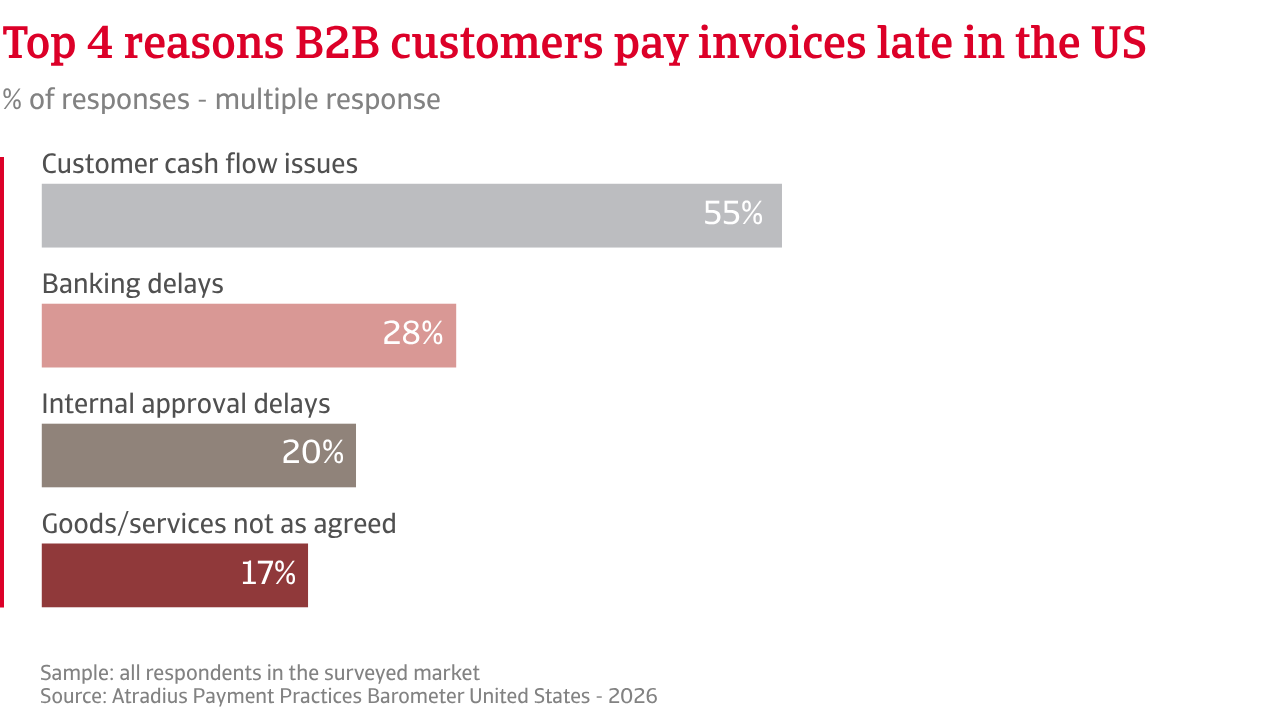
B2B customers often do not have enough cash to settle invoices on time. This is the main reason payments are risky. This problem affects both the US and North America. In the US, 55% of suppliers report B2B customers delay invoice payments. They mostly report that customers experience liquidity issues. This is seen more often in the US than in other parts of North America. US companies also face other problems more frequently. These include goods or services not delivered as promised. They also have technical issues with online payment systems. Slow internal approval processes are another common reason for delayed payments from B2B customers. However, in the markets surveyed in the region, businesses point to different challenges. They often mention slow bank processes. Difficult payment methods are also a frequent complaint.
Although many US suppliers get paid late by other companies, most B2B customers settle their overdue invoices within one month past due. This usually allows suppliers to get cash from sales within about two months of invoicing. This is shown by data on Days Sales Outstanding (DSO). This pattern is similar across most of North America, but Mexico is different.
However, some late payments are never collected. The main reason companies lose revenue to bad debt is when invoices remain unpaid for a long time. Another most often cited reason is when customers stop being active or cannot be reached. US companies often report losing 1% to 2% of their B2B invoices as bad debt. This is more common than for other companies in the region. In Mexico, however, companies often report losing more, between 2% and 5%. This means Mexico has a more challenging payment risk environment.
Customer payment issues affect a company's working capital in similar ways in the US and other parts of North America. The most common result is having less cash on hand. Firms in both the US and North America also report similar difficulties in planning how their cash flows in and out of the business. Compared to other North American firms, US companies are less likely to say they can't invest. They also rarely report higher costs for borrowing money or needing to pay suppliers late. But US businesses are more likely to get outside loans to help them when B2B customers settle invoices after the due date.
Businesses in the US and North America use similar tools to deal with the risk of customers not paying. But they use these tools in different ways. In most of North America, businesses often ask for cash up front. Or they ask for a secure payment or payment ahead of time. This is not as common in the US. Instead, US companies tend to manage credit very actively. They check customer credit, watch how customers pay, and use digital tools to help collect money. US businesses also offer rewards for paying early. They use tools like automatic messages and online payment options to collect money.
In the US, 55% of suppliers report B2B customers delay invoice payments
Around one in five companies in both the US and across North America report using credit insurance to mitigate the impact of customer payment risk on their business. Firms say it helps address uncertainty around the payment behaviour of B2B customers, protecting against potential losses while supporting continued trade on credit. The use of negotiated payment terms and customer diversification strategies is also notably consistent between the US and the wider region. Overall, this suggests that US businesses take a balanced approach to payment risk management, combining risk transfer and risk mitigation tools to support stable trading relationships and cash flow resilience.

Looking ahead, US businesses are more likely than their North American peers to expect stable payment behaviour among B2B customers. Around two-thirds anticipate no change in payment patterns in the months ahead, while fewer expect either improvement or deterioration. However, medium and large trading companies are more cautious, with a higher proportion expecting payment performance to worsen as the year progresses.
Consistent with this outlook, more than three in five US businesses expect customer insolvency risk to remain stable in the months ahead, while just over one in four anticipate an increase. Overall, US businesses appear to take a measured view of risk. While they recognise the challenging economic environment and the prospect of rising insolvencies nationwide, most expect both customer payment behaviour and insolvency risk within their own trading relationships to remain broadly stable, indicating some confidence in the resilience of their trading relationships.
Despite expecting customer payment behaviour and insolvency risk to remain broadly unchanged in the months ahead, US businesses are more optimistic about future profitability than their North American peers. More than half expect profit margins to improve over the next 12 months, significantly above the regional average. This suggests that businesses are not relying on better payment performance to strengthen their financial position. Instead, many appear confident in their ability to improve profitability through operational efficiency, effective cost management, pricing strategies, and resilient customer relationships.
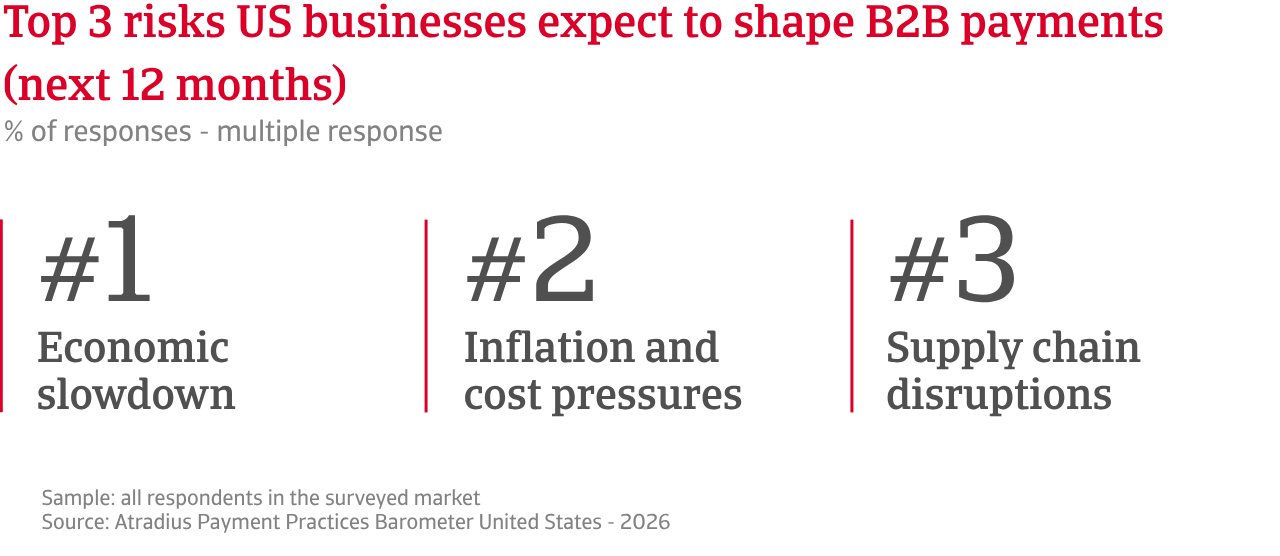
When asked about the factors most likely to disrupt B2B customer payment behaviour in the months ahead, US businesses cite a potentially slowing economy as the primary concern. They are also more concerned about inflation and cost pressures than their North American peers. Expectations of weaker economic growth, driven by supply chain disruptions and rising costs, continue to weigh heavily on business sentiment. These risks rank among the key concerns and are cited more frequently by US firms than by businesses across the wider region. Fraud risk is also viewed as a significant threat by businesses in both the US and North America. Interestingly, US companies are less concerned than their regional peers about cybersecurity risks, regulatory changes, currency volatility, and sector-specific downturns. This suggests that concerns about economic growth and cost pressures currently outweigh other potential sources of B2B payment disruption.
Taken together, these findings suggest that US businesses remain highly aware of the economic risks that could affect customers' ability to pay in the months ahead. While they recognise the challenges posed by economic slowdown and inflation, they also appear confident in their ability to manage uncertainty, protect cash flow, and continue trading on credit. This is reflected in the range of payment risk management strategies used by US businesses, including for some firms, risk transfer solutions involving credit insurance.
For a full overview of the 2026 survey results for the US, please download the market-specific report from the related documents section below. Insights into North America are available in the related content section below.
To explore how to strengthen your own credit risk strategy, get in touch with us and see how we can help you stay ahead.
